
Products

StructSense: accelerometer nodes for structural health monitoring

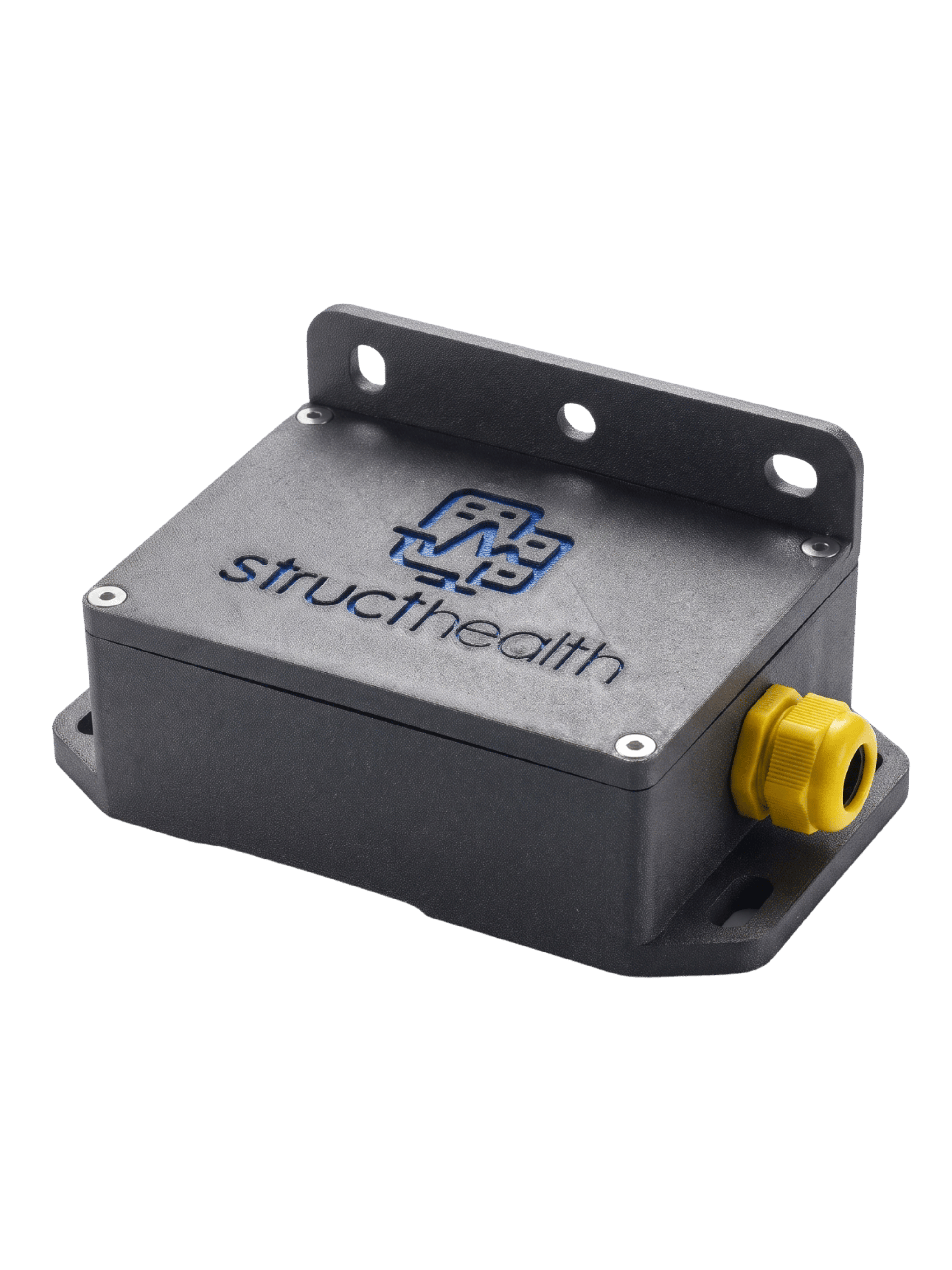
The StructSense family consists of four accelerometer nodes that differ mainly in noise level, from a standard model for routine projects to a seismic-grade model for very low ambient vibration. All nodes measure three-axis acceleration and transmit data over Ethernet with Power over Ethernet (PoE).

Request the datasheetStructSense accelerometer node
Model comparison

Model
Code
Noise density
ADC resolution
Two-axis tilt
StructSense Seismic
SH-A1100
0.02 µg/√Hz
32-bit
Optional
StructSense Elite
SH-A1000
0.2 µg/√Hz
32-bit
Optional
StructSense Ultra
SH-A900
0.9 µg/√Hz
32-bit
Included
StructSense Core
SH-A020
25 µg/√Hz
24-bit
Included

Noise density refers to the acceleration channel.

Common specifications

Acceleration axes
3 (X, Y, Z)
Measurement range
±2 / ±4 / ±8 g, user-selectable; up to ±20 g optional (high-frequency version)
DC-level acceleration noise
< 1 µg RMS
Non-linearity
±0.1 % FS
Frequency response
DC to 500 Hz; up to 20 kHz optional
Output data rate
100 / 200 / 400 sps, user-selectable; up to 64 ksps optional (high-frequency version)
Tilt output resolution
0.0055 °/LSB
Tilt noise density
0.001 °/√Hz
Interfaces
100 Mbit Ethernet with PoE; optional CAN, RS422 or RS232 (256 or 512 kbps)
Time synchronisation
Sync input (1 ms resolution); offline time synchronisation over Ethernet
Power
5–30 V DC industrial input with protection, or PoE
Operating temperature
−40 to +80 °C (storage −40 to +85 °C)
Enclosure
Aluminium, IP67
Dimensions
72 × 88 × 50 mm
Weight
850–1200 g depending on configuration, excluding mounting plates

On-board features

Self-test, temperature sensor, internal memory for 120-second earthquake records, optional relay alarm output and optional USB external memory.

Real-time analysis

PGA, PGV, Arias intensity, CAV, PSa, PSv, Sd, spectrum intensity, tilt change per node, vibration-based intrusion detection and predictive maintenance analysis.

StructSense measures and reports acceleration and tilt changes. The data supports the structural engineer's assessment; decisions about the condition of a structure remain with the engineer.